
Every agency talks about results. We prefer to show them.
This is the story of how we helped a mid-sized UK client double their Google Ads ROI in under 90 days — not through massive ad budgets or magic tricks, but through strategy, testing, and a laser-sharp focus on performance.
If you’re a business owner or marketer wondering how to get real value from your Google Ads campaigns, this case study lays it all out: the challenge, the strategy, and exactly what worked (and what didn’t).
Let’s get into it.
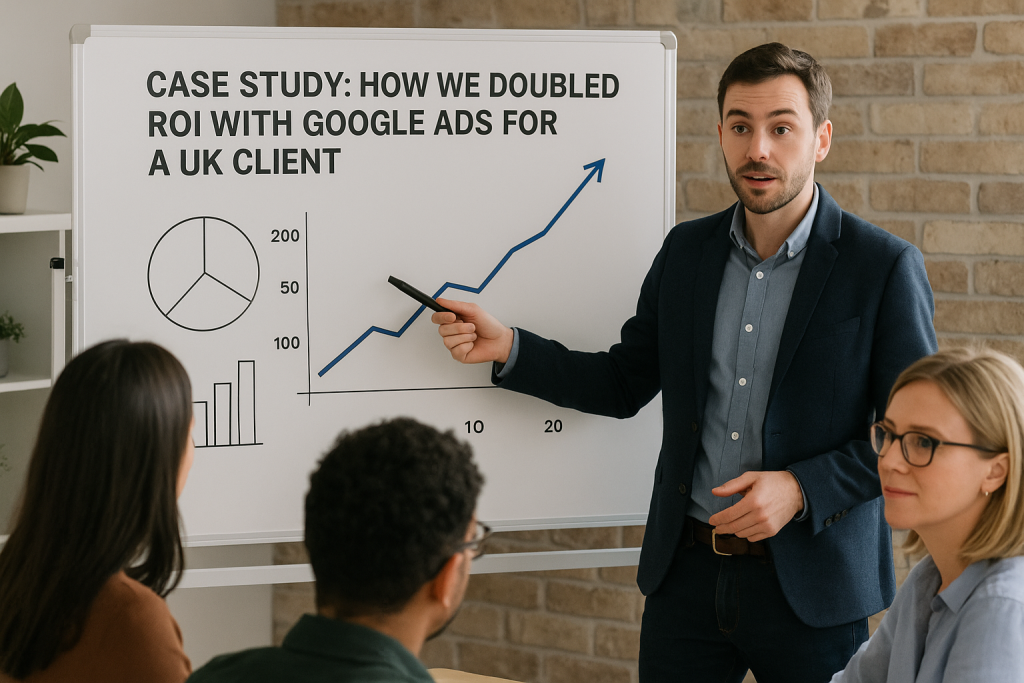
The Client: A Growing B2C E-Commerce Brand in the UK
Our client was a UK-based direct-to-consumer brand in the home essentials space. They sold premium but affordable products — think smart storage, minimalist decor, functional design — all through their own website.
They weren’t new to Google Ads, but after more than a year of running search campaigns, things had plateaued:
- Average monthly ad spend: £3,000
- Return on ad spend (ROAS): ~1.6x
- No consistent scaling strategy
- Poor visibility into what was really driving results
Their in-house team had tried their best but were struggling to make the account profitable — especially with rising CPCs and shrinking margins.
That’s where we came in.
The Goal: Sustainable Growth with Measurable Return
The client wasn’t asking for a miracle. They wanted:
- A clear PPC strategy
- A data-driven path to scaling their monthly sales
- And most importantly, a minimum 2x ROI across all campaigns
We gave ourselves 90 days to hit that benchmark, with the longer-term goal of building a system they could grow into.
Our Approach: Fix the Foundation Before Scaling
We always start with a simple truth: Google Ads ROI doesn’t come from spending more. It comes from spending smarter.
So before we built anything new, we audited everything they already had.
Step 1: Full Account Audit
The campaign structure was chaotic — keyword overlap, broad match issues, and too many ad groups cannibalising each other.
We found:
- 60% of spend going to low-converting broad match keywords
- No use of conversion value rules or automated bidding
- Landing pages not aligned with ad copy
- No segmented targeting by device or location
We ripped it down to the studs.
Step 2: Restructuring for Intent & Relevance
We rebuilt the campaign structure based on search intent. That meant splitting campaigns into:
- High-intent branded terms (e.g. “[brand] storage bins”)
- Product-category keywords (e.g. “minimalist shoe rack UK”)
- Feature-focused searches (e.g. “foldable laundry baskets”)
- Competitor targeting
Each campaign got its own landing page, budget, and bid strategy.
We also:
- Shifted from manual CPC to Maximise Conversion Value bidding
- Layered in audience targeting (returning visitors, cart abandoners)
- Set up ROAS-based bidding goals to track profit directly
Step 3: Geo & Device-Based Optimisation
Next, we reviewed the performance by region and device type.
What we found surprised the client:
- Mobile traffic accounted for 74% of total conversions but had 28% lower ROAS
- London, Manchester, and Birmingham had better CPCs and conversion rates than smaller towns, despite receiving less budget
We reallocated budget accordingly:
- Increased mobile bid adjustments by 15%
- Focused spend on top-performing cities
- Excluded underperforming regions to reduce waste
That’s one of the benefits of Google Ads for UK businesses — with smart location targeting, you can double down on high-converting zones and eliminate irrelevant clicks in just a few clicks.
Step 4: Creative & Copy Overhaul
Let’s be real: the ad copy wasn’t doing them any favours.
Most of the ads were generic:
“Shop Smart Storage – Free Delivery – Great Prices”
We rebuilt the ads with a stronger emotional and functional appeal. Here’s a before-and-after:
Before:
“Buy Laundry Hampers – 10% Off All Orders”
After:
“Hide Clutter in Seconds – Foldable Hampers That Look Good Too | Free UK Delivery”
We added:
- Ad customisers to dynamically insert product categories
- Countdown timers for urgency
- Location extensions to drive trust
We also ran A/B tests weekly to identify top-performing headlines, CTAs, and product names.
Step 5: Conversion Tracking & Attribution Fix
This might be the most underrated part of this case study.
The client’s existing tracking setup was only counting form submissions. No product page views. No add-to-cart data. No checkout starts. No revenue.
We implemented:
- Full eCommerce tracking via Google Tag Manager
- Enhanced conversions for Google Ads
- Integration with Google Analytics 4 and server-side GTM
Now we could see:
- Revenue per keyword
- Conversion path length
- Post-click attribution windows
This allowed us to trim wasted spend and reinvest in the highest-profit campaigns. The difference this made? Massive.
The Results: 2.1x ROAS in 90 Days — and Climbing
Here’s the bottom line.
In 90 days:
- ROAS grew from 1.6x → 2.1x
- Revenue from Google Ads increased by 61%
- Cost per conversion dropped by 28%
- The client’s team finally felt in control of their growth
But more than just hitting numbers, the client now had a scalable system. One they understood. One that worked.
They’ve since grown their budget from £3,000 to £7,500/month — and we’re continuing to optimise as we scale.
What We Learned: Lessons You Can Apply Right Now
Every client is different, but the principles behind this success story apply across industries — whether you’re selling home goods, running a service business, or scaling e-commerce.
Here’s what mattered most:
1. Structure Drives Performance
Sloppy account setup kills ROI. Once we rebuilt campaigns by intent and cleaned up keyword overlap, performance skyrocketed. Good structure gives Google’s machine learning room to breathe — and gives you clearer data to act on.
2. Location Targeting Isn’t Optional
It’s not just about saving money — it’s about showing up where your most valuable customers actually are. By focusing our Google Ads campaigns on top-performing UK cities and excluding underperformers, we boosted relevance and reduced wasted spend.
3. Stop Guessing. Start Tracking.
If you’re not tracking every meaningful action — from add-to-carts to phone calls to purchases — you’re flying blind. Accurate data is what lets you optimise for real ROI, not just vanity metrics.
4. Ad Copy Isn’t Just Decoration
Words matter. Ads that connect emotionally and speak to the user’s problem convert better. Simple tweaks like including city names, pain points, and urgency made a noticeable difference.
5. You Don’t Need a Huge Budget to Win
We didn’t triple the budget. We just used it smarter. Strategic bidding, audience segmentation, and campaign exclusions stretched every pound further — and that’s a win for any business.
The Bottom Line: ROI Is Built, Not Bought
This wasn’t about some hidden PPC trick. We didn’t just “hack” the algorithm or throw more money at the problem. We built a Google Ads strategy tailored to the client’s business, customers, and goals — then we executed it with discipline and care.
And we can do the same for you.
If you’re a UK-based business tired of underperforming campaigns, rising costs, or “meh” results from your current provider, it might be time to talk.
Ready to See What Google Ads Can Really Do for Your Business?
At DigitalMarketingAds.co.uk, we help UK businesses like yours grow with:
- ROI-focused Google Ads management
- Bulletproof conversion tracking
- Smart location targeting
- Transparent, results-first strategy
Whether you’re launching your first campaign or scaling what already works, we’ll help you cut the noise and start getting real results.
👉 Book your free strategy session now — and let’s make your next campaign the one that finally delivers.
Conclusion
Doubling ROI with Google Ads isn’t about luck or massive budgets — it’s about clarity, strategy, and execution. This case study proves that with the right campaign structure, smart location targeting, and precise tracking, local UK businesses can unlock serious growth.
Whether you’re struggling with high costs, low conversions, or just not knowing what’s working, the solution isn’t always “spend more.” Sometimes, it’s just about spending smarter.
And with the right partner, that kind of transformation isn’t just possible — it’s repeatable.
Ready to see what your next 90 days could look like? We’re here when you are.
Frequently Asked Questions
1. How long does it take to see ROI improvements with Google Ads?
It depends on your industry, budget, and current setup, but most of our UK clients begin seeing measurable ROI improvements within 30–90 days after restructuring and optimisation.
2. What’s the difference between ROAS and ROI in Google Ads?
ROAS (Return on Ad Spend) focuses on how much revenue you generate per £1 spent on ads. ROI (Return on Investment) factors in your full costs — including product margins and operational expenses — giving a clearer picture of overall profitability.
3. Can local businesses compete with bigger brands on Google Ads?
Yes — with smart location targeting, well-structured campaigns, and relevant ad copy, smaller businesses can outperform larger competitors in local markets. Precision beats scale when it’s done right.
4. Do I need a big budget to get good results from Google Ads?
Not at all. We’ve helped clients see strong ROI starting with monthly budgets as low as £1,000. The key is how you use your budget — targeting the right people, in the right places, at the right time.